

Model selection, use case prioritization, and vendor evaluation: every AI strategy needs to answer these. What’s easy to skip is whether the data feeding all three answers is trustworthy enough to act on. ATCS, an engineering firm managing complex, multi-phase construction projects, approached this question head on.
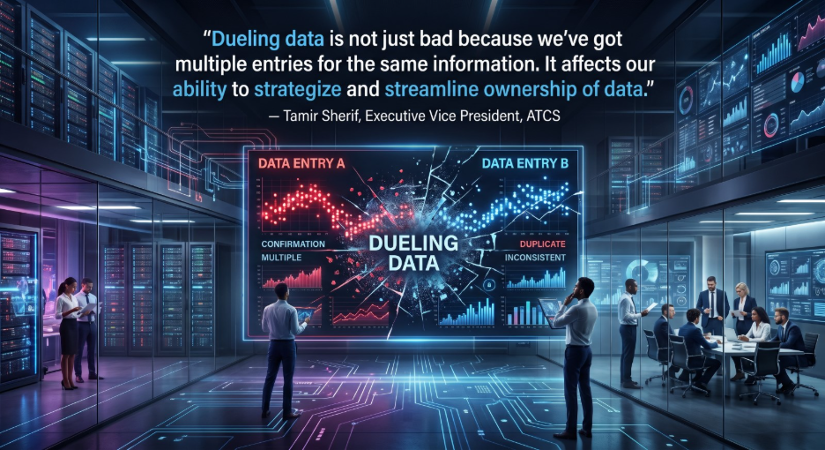
Three decades of steady growth had left it with a series of disconnected systems: financial data in Deltek, payroll in ADP, construction site images and videos sitting in storage but effectively invisible to other teams. Department leaders couldn’t independently pull the data relevant to their own work, and the same project numbers were often calculated differently depending on which system you asked. ATCS’s own team had a name for this: dueling data.
That’s a governance problem before it’s an AI problem. It’s why ATCS partnered with dbSeer to build a Databricks lakehouse on AWS, not as a technology upgrade, but as the foundation that would eventually make AI and advanced analytics possible.
ATCS’s situation is more common than it might seem. Gartner predicts that through 2026, organizations will abandon 60% of AI projects unsupported by AI-ready data and separately found that most organizations either lack or aren’t sure they have the right data-management practices to support AI at all. Technology rarely fails first: the data underneath it does.
As a Databricks Consulting Partner and AWS Advanced Partner, dbSeer brought both platform expertise and hands-on delivery experience to ATCS’s engagement. That dual partnership mattered here: the Databricks workspace was deployed inside ATCS’s existing AWS environment, so the lakehouse could draw on native AWS integrations for storage and compute rather than forcing ATCS to choose between the two ecosystems or stitch them together after the fact. dbSeer is also actively pursuing membership in the Claude Partner Network, Anthropic’s partner program for organizations building on Claude. Databricks and Anthropic signed a five-year partnership making Claude models natively available through the Databricks Data + AI Platform. dbSeer’s fluency across platforms matters for any client evaluating what’s next on their own Databricks foundation.
Table of Contents
A Foundation Built in Layers
dbSeer’s approach followed the medallion architecture native to Databricks’ Data Intelligence Platform: bronze, silver, and gold layers that progressively refine data rather than fixing everything at once, all stored in Delta Lake’s open format so data stays queryable and portable rather than locked into a proprietary structure.
Bronze ingests raw data exactly as it comes in from Deltek, ADP, and, for the first time, the construction site images and videos that had never been searchable against project records.
Silver is where the real work happens: cleansing recent years of accumulated inconsistencies, since that is where reconciling Deltek project hours against ADP payroll costs pays off most, and merging them into unified views that didn’t exist when the systems operated in silos. It’s also where dbSeer established the consistent business logic that ensures everyone calculates the same metric the same way. No more dueling data.
Gold delivers role-specific views, portfolio status for project managers, financial performance for executives, revenue recognition for finance, feeding directly into BI dashboards that replaced a manual Excel reconciliation ritual.
The layered approach lets an organization see value early, without needing every system perfectly reconciled on day one. ATCS started resolving disconnects between its ERP systems almost immediately, well before the platform was fully mature.
Governance Makes the Data Usable, Not Just Clean
The layer doing the most structural work is Unity Catalog, now live within ATCS’s environment as the platform’s governance layer. It manages access controls so a project manager sees their own projects while an executive sees across the organization, without maintaining separate permission logic for every tool that touches the data.
That single permission model does double duty. In the past, this level of consistency wasn’t really achievable: every time a new dashboard or a new AI tool needed to touch the data, someone had to manually check and set up access rules for that specific system, tier by tier, one by one. Multiply across a growing list of tools and teams, and gaps are almost inevitable. A dashboard might get access locked down properly while a newer AI process pulling from the same data doesn’t, simply because nobody re-ran the same checks for it. Unity Catalog removes that manual, per-system work. Access rules, including which fields get masked for privacy or compliance, like payroll or PII, are defined once, in one place, and applied automatically wherever the data is used, whether that’s a dashboard or an AI agent. Nothing has to be individually reconfigured or re-checked for each new use case. This is Unity Catalog doing what it’s built to do, not a new security system dbSeer layered on top of ATCS’s data. The result is one governed environment that holds up to scrutiny from inside the organization and from outside auditors, clients, or partners alike.
The even more consequential story is what governance unlocks next. The plan is to populate the catalog with additional metadata: documenting what each table and column means, not just what it’s named. Once that’s in place, the platform becomes self-describing, and that’s the point where AI on top of the data becomes trustworthy rather than speculative. A model that knows a column is called “total_hrs” is far less useful than one that knows what that exact field represents. Unity Catalog is built to carry that context forward, so whatever sits on top, a dashboard, a model, a generative AI assistant, inherits the same governed meaning of the data underneath it.
This is what dbSeer calls a smart foundation: building the architecture today so the capability is already there when the organization is ready to act on it. ATCS isn’t waiting for AI to become urgent before preparing for it. It’s building from a position of strength, not catching up.
The Takeaway
Most established organizations have some version of dueling data: the same numbers, calculated differently, living in systems never designed to talk to each other. The instinct is to jump straight to the exciting part, the dashboard, the AI assistant, and treat the underlying data as a problem for later.
That instinct isn’t reserved for laggards. McKinsey found that even 70% of its gen AI “high performers” report real difficulty with data governance, integration, or training-data quality. Maturity doesn’t make the data problem disappear. It changes when an organization chooses to face it, not whether it has to.
ATCS wasn’t fixing something broken. Three decades of steady growth had already proven the business works. What ATCS recognized is where the market is heading: data is becoming the thing everything else runs on, and getting the foundation right now means the organization is ready to act when AI becomes the next step, instead of scrambling to catch up later.
ATCS’s experience suggests the order works better: build the governed foundation first, and let everything downstream, better dashboards, cleaner reporting, and eventually AI, get easier and more trustworthy to build.
Read the full ATCS case study for the complete story of how dbSeer and ATCS built this foundation together.