
The Goddard School operates one of the largest early childhood education franchise networks in the country, with more than 600 locations nationwide. At that scale, pricing isn’t a single decision; it’s hundreds of decisions, each shaped by local competition, school performance, and shifting market conditions. Getting it right matters directly to franchisees’ businesses and to the families they serve.
That responsibility has always sat with Goddard’s pricing analysts, and it was never the only thing on their plate. It sat alongside a full workload, and twice a year it demanded a comprehensive pull across all 600-plus locations: internal tuition data, competitor pricing, occupancy rates, demographics, and regional market conditions, synthesized into tiered, market-aware recommendations for every franchisee. That work has always taken real time, and it has always required real judgment, an analyst who understands not just the numbers, but what they mean for a given market.
That expertise isn’t going anywhere, and it shouldn’t. What’s changed is how much of an analyst’s day gets absorbed by the ad-hoc questions that arrive between the twice-yearly cycles, each one competing with everything else on their plate for the same limited time. That’s where dbSeer’s Analyst Assist enters: an agentic AI system that encodes the analyst’s own judgment so routine questions can get answered without pulling someone away from the rest of their job, while the analyst stays the authority on anything that needs a real judgment call.
Table of Contents
The Challenge
Goddard’s pricing data was fragmented across spreadsheets with no single home: scattered by school, market, and program. Turning that raw data into something actionable required manual work and repeated validation, cycle after cycle. Goddard wanted to know whether GenAI could bring that data into one space and let business users ask natural questions of it, surfacing patterns faster, but they were deliberate about how they wanted to test that.
As Goddard’s Chief Information Officer, Dr. Ali Tafreshi, explained they kept the engagement scoped as proof of concept to test feasibility and figure out what data quality and guardrail work would be needed before going further. That caution is exactly why the results are credible.
The dbSeer Approach
dbSeer’s foundation-first, modular approach meant Goddard didn’t have to commit to a fully built system before seeing results. The engagement followed the same path as every dbSeer AI Accelerator: identify the right use case, prove it works against real data, and only move forward once the value is clear.
An AI-Ready Data Foundation
dbSeer designed and implemented a pipeline that ingested, cleaned, and transformed Goddard’s multi-source data into a structured, AI-ready dataset.
This is also where dbSeer’s DataOps discipline picks up: once a foundation like this is built, DataOps is what keeps it trustworthy over time, monitoring pipelines and catching data quality issues before they reach a report.
A Knowledge Base Built from Analyst Expertise
Rather than building a generic assistant, dbSeer worked directly with Goddard’s pricing analysts to document and encode their judgment: how to weigh one market against another, how to interpret occupancy trends, how to flag an outlier. That comparative reasoning became the system’s reasoning layer. The AI augments the analyst’s expertise for the time-consuming process.
A Natural-Language Interface
The final system, built on Amazon Bedrock using Claude Sonnet and a custom agentic framework, lets authorized users query Goddard’s pricing data the way they’d ask a question of a human analyst. It interprets the question, generates a structured data query, retrieves and displays the raw results for transparency, and delivers a contextual narrative response along with follow-up questions to guide deeper exploration.
Ask “which markets are grossly over or underpriced?” and the system identifies specific locations, quantifies the gap relative to the market, and surfaces the cases for review.

Where It Stands
What began as a proof of concept has advanced to a live pilot deployment, a milestone that reflects the confidence Goddard places in the system’s function. This is not yet a full 600-location rollout. It’s a deliberate, controlled pilot serving a focused group of executives and senior analysts using dbSeer’s Analyst Assist, by design, so Goddard can validate value before scaling further.
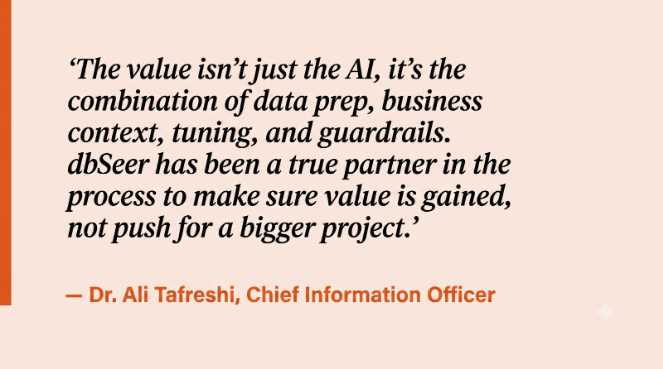
“The biggest win was turning a vague ‘AI for pricing analytics’ idea into something concrete we could actually evaluate with our own data. dbSeer helped us structure the data, catch inconsistencies, and work through market-mapping questions, then checked outputs against questions our team cared about. We now have a much better sense of where GenAI actually helps, where we still need human judgment, and what needs fixing before this could scale.” -Dr. Ali Tafreshi, Chief Information Officer, The Goddard School
Why dbSeer
By embedding the judgment of Goddard’s own analysts into the system’s architecture, dbSeer delivered something that feels like an extension of the existing team rather than a black box.
This is the foundation of dbSeer’s AI Accelerator, a structured six-week program, built on Amazon Bedrock and Anthropic’s Claude, that takes organizations from idea to working solution with a built-in go/no-go gate between discovery and build. Goddard followed exactly that path: use case discovery first, a validated proof of concept on real data, then a controlled pilot.
Interested in what AI can do for your organization, or in building your own version of an Analyst Assist? The dbSeer AI Accelerator is available for qualified engagements, with AWS POC funding that may apply. Contact [email protected].